
Author: Site Editor Publish Time: 2026-02-23 Origin: Site
The industrial landscape is undergoing a massive shift toward electrification. Manufacturers are rapidly replacing traditional pneumatic and hydraulic systems with modern electric actuation. This transition offers superior precision, real-time data feedback, and significantly lower energy costs. However, navigating the market is difficult. The term "electric actuator" encompasses a vast range of hardware, from micro-devices in medical tools to multi-ton lifters in heavy construction. This diversity creates a confusing selection process for engineers and procurement managers.
You cannot simply pick a part number from a catalog without understanding the underlying mechanics. The "best" actuator depends entirely on your specific motion profile, space constraints, and environmental conditions. This guide breaks down the critical distinctions between actuator types based on mechanical design and application suitability. By understanding these core differences, you can make informed engineering decisions that optimize performance and reduce total cost of ownership.
Motion First: Selection begins with the fundamental requirement: Linear (push/pull) vs. Rotary (torque/angle).
Drive Mechanics Matter: The choice between lead screws, ball screws, and belts dictates precision, speed, and duty cycle.
Form Factor vs. Space: Inline, right-angle, and track designs solve different geometric constraints within machinery.
TCO Reality: While initial costs are higher than pneumatic cylinders, electric actuators offer lower operating costs (energy/maintenance) and superior control.
To select the right component, you must understand what happens inside the housing. The Electric actuator working principle relies on converting electrical energy into mechanical torque, which is then translated into linear or rotary motion.
If you look at a standard Electric actuator diagram, you will typically find four distinct subsystems working in unison:
Motor: This is the power source. It is usually a brushed or brushless DC motor, though stepper and servo motors are used for high-precision applications.
Gearing: High-speed motor output must be reduced to increase torque. Manufacturers use spur gears, planetary gears, or worm drives to achieve the correct speed-torque ratio.
Drive Mechanism: This component converts rotary motion into linear movement. Common types include a lead screw (spindle) and driving nut, or a rack and pinion system.
Feedback: Sensors like Hall effect devices, potentiometers, or optical encoders track position. They tell the system exactly where the actuator is at any given moment.
The actuator itself is the muscle. It pushes, pulls, or turns based on the energy it receives. The controller acts as the brain. It sends signals to the motor to extend or retract the rod. In sophisticated systems, the controller monitors current draw and position feedback to prevent damage and ensure precise repeatability.
When engineers ask What are the different types of electric actuators?, they are usually looking for a classification based on mechanical structure. The physical design determines how the unit integrates into your machine.
This is the most recognizable form factor. An internal screw spins, forcing a drive nut to move an extendable tube (the rod) in and out of the main housing.
Best Use: Pushing, pulling, lifting, or pressing in open environments.
Pro: These units are easy to seal. High IP ratings (IP66/IP67) protect internal components from dust and water, making them ideal for outdoor or washdown use.
Con: The total length extends significantly during operation. Furthermore, the extended rod is susceptible to bending (buckling) if subjected to side loads.
Instead of an extending rod, a carriage slides along a fixed rail or track on the actuator body. The overall length of the unit remains constant during operation.
Best Use: Applications requiring a fixed footprint, such as medical scanners or adjustable furniture where space is tight.
Pro: It eliminates the need for extra clearance space for rod extension. The track design handles side-loading and moment loads far better than rod-style versions.
Con: sealing the sliding track against harsh environments is difficult. These units typically have lower IP ratings than rod-style counterparts.
Lifting columns utilize telescopic multi-stage tubes to provide vertical motion. They function like a rod actuator but are built to be structurally self-supporting.
Best Use: Height-adjustable desks, medical beds, and ergonomic industrial workstations.
Unique Benefit: They offer high stability and a long vertical reach while maintaining a very low retracted height.
The orientation of the motor relative to the drive screw changes the shape of the actuator. This geometric difference helps solve specific packaging problems.
The motor, gearbox, and lead screw sit in a straight line. This creates a streamlined, tube-like appearance.
Trade-off: This layout offers the slimmest profile, which is excellent for aesthetics or fitting inside tubes. However, it results in the longest retracted length because the motor sits behind the screw.
The motor sits alongside the drive screw, parallel to the main body. Gears or a timing belt connect the motor shaft to the screw.
Trade-off: This design significantly reduces the overall length of the unit. It also allows manufacturers to easily swap gear ratios to customize speed and force capabilities without changing the housing.
The motor is mounted perpendicular to the drive screw, typically using a worm gear set.
Trade-off: These are efficient users of corner space. The worm gear mechanism provides very quiet operation and inherent self-locking capabilities, meaning the load typically won't back-drive the motor when power is cut.
The internal mechanism that converts rotation to linear motion defines the performance characteristics. This is a critical engineering detail often overlooked during initial selection.
| Drive Technology | Friction Type | Characteristics | Ideal Applications |
|---|---|---|---|
| Lead Screw (Acme) | Sliding Friction | Quiet, cost-effective, often self-locking. | Low-to-medium duty cycles; intermittent adjustments. |
| Ball Screw | Rolling Friction | High efficiency, high duty cycle, expensive. | Continuous industrial automation; heavy loads. |
| Belt-Driven | Pulley System | Very high speed, long stroke, lower force. | Pick-and-place robots; rapid transport lines. |
These rely on sliding friction between the nut and the screw threads. They are quiet and usually self-locking, meaning they hold their position without power. They are ideal for applications with low-to-medium duty cycles where cost is a factor.
Ball screws use recirculating ball bearings to reduce friction. They offer high efficiency and can run continuously without overheating. However, they are more expensive and are not self-locking; you must use a brake to hold the load in place.
Instead of a screw, a belt drive moves the carriage. These systems provide rapid linear motion and long stroke capabilities, making them perfect for automation tasks like packaging lines or material handling.
While linear motion is common, many industrial processes require rotation. Types of actuators in the process control sector are specifically designed to operate valves.
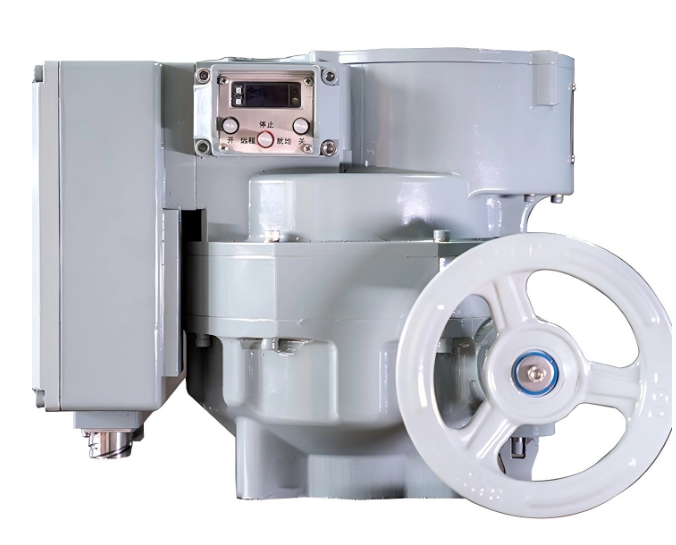
These units rotate a shaft exactly 90 degrees. They are used primarily for controlling ball valves and butterfly valves. The key requirement here is high torque at the start and end of the stroke to seat and unseat the valve mechanism.
Some valves, like gate valves or globe valves, require multiple full rotations to open or close. Multi-turn actuators provide continuous rotation with precise torque limiting to prevent damage to the valve stem.
Cut-Off actuators operate simply: fully open or fully closed. They are used for on/off control. Regulating actuators accept analog signals (like 4-20mA) to modulate flow precisely, positioning the valve at any angle between 0 and 90 degrees.
Selecting the right hardware requires a systematic approach. Engineers typically follow a specific logic path. Here is How to choose an electric actuator? without overspending or underspecifying.
Start with the basics. Calculate the dynamic load (the weight you move) and the static load (the weight you hold). Determine your required speed. Remember that high speed usually requires lower force per watt. Categorize your need: are you looking for a Micro unit (~200N), a Utility unit (~2000N), or an Industrial beast (6000N+)?
Electric motors generate heat. You must define the operating percentage. If the unit runs 10% of the time and rests 90%, a lead screw is fine. If it runs 100% continuously, you need a ball screw or brushless motor system to prevent burnout.
Where will it live? If the device is outdoors, you need IP66 or IP67 ratings for water resistance. If it is in a food processing plant, you might need IP69K for high-pressure washdowns. Also, consider mounting. Will you use a Clevis (pivot) mount, a Trunnion, or a rigid flange?
Not all suppliers are equal. When vetting an electric actuators manufacturer, look for customization capabilities. Can they adjust stroke lengths? Do they offer 3D CAD files for your design team? Check if they provide integrated controllers or if you need to buy external drivers separately.
Switching to electric actuators brings immense benefits, but you must watch out for common implementation pitfalls.
Standard rod actuators are designed for axial loads only (pushing straight out). Radial forces or side loads will bend the rod and destroy the seals. If your application involves side-loading, you must use external guide rails or switch to a track actuator.
If power is cut, will the load fall? Ball screw actuators can back-drive easily. To prevent injury or damage, you must ensure the system includes a mechanical brake or choose a worm-gear design that is inherently self-locking.
The upfront price tag of an electric system is often higher than a pneumatic cylinder. However, the TCO is usually lower. Pneumatic systems suffer from expensive air leaks and high compressor maintenance costs. Electric systems consume energy only when moving, providing long-term savings and a cleaner manufacturing environment.
The "best" actuator is strictly defined by the geometry of your space and the physics of your load. Whether you need the raw power of a hydraulic replacement or the compact precision of a track actuator, the market offers a solution. Success comes from a "requirements-first" approach. Define your Force, Speed, and Stroke parameters before you ever open a catalog.
Do not guess when it comes to motion control. Consult with an experienced application engineer to validate your sizing calculations. A well-chosen electric actuator will provide years of maintenance-free operation, precise control, and significant energy savings.
A: The four broad categories are What are the 4 types of actuators and their uses? focuses on: Electric (clean, precise automation), Hydraulic (heavy lifting, construction), Pneumatic (fast, simple factory automation), and Mechanical (manual gears/levers). Electric actuators are increasingly replacing the others due to better control and efficiency.
A: Which type of actuators are the most commonly used? depends on the industry. For general utility and home automation, linear rod-style electric actuators are the standard. In process control and piping systems, rotary quarter-turn actuators are the most common for managing valves.
A: A solenoid is designed for short, instant, on/off movement (like a latch). An electric actuator provides a controlled stroke with variable speed and intermediate positioning capabilities. Actuators are for precise motion profiles, while solenoids are for binary switching.
A: Yes. Modern industrial electric actuators can generate forces exceeding 15,000N (over 3,300 lbs). They are replacing hydraulic cylinders in many heavy-duty applications to eliminate fluid leaks, reduce maintenance, and improve positional accuracy.


