
Author: Site Editor Publish Time: 2026-09-08 Origin: Site


Selecting the right electric valve actuator requires more than matching a motor to a valve. The actuator must provide enough torque or thrust, move the valve through the correct travel, operate at the required speed, communicate with the control system, withstand the surrounding environment, and meet the safety requirements of the application.
For industrial users, an incorrectly selected actuator can create problems such as incomplete valve travel, excessive motor loading, inaccurate positioning, frequent trips, accelerated wear, or failure to operate when the process requires it most.
A good selection process therefore begins with the valve and operating conditions, then works outward to the actuator.
When evaluating an Electric Valve Actuator, consider these core factors:
valve type → required torque or thrust → travel → duty cycle → control mode → power supply → environment → safety requirements → communication → maintenance
The first selection question is simple:
What type of valve must the actuator operate?
Different valves require different types of movement.
Ball valves, butterfly valves, plug valves, and many dampers usually require approximately 90° of rotary movement.
For these applications, a part-turn or quarter-turn actuator is normally appropriate.
Yangzhou Hengchun's current product range includes part-turn intelligent electric actuators designed for butterfly valves, ball valves, and dampers, with standard rotary travel around 0–90° and extended travel available for certain applications.
Gate valves, globe valves, and similar designs may require multiple shaft rotations to move from fully closed to fully open.
These applications normally require a multi-turn electric actuator.
The actuator must be selected according to:
valve stem torque,
number of turns,
stem configuration,
seating requirement,
and required closing force.
Some control valves require linear stem movement rather than direct rotary output.
In these cases, the electric actuator may need a linear conversion mechanism or a configuration designed specifically for linear thrust.
The important principle is:
match the actuator output motion to the valve movement first.
Torque is one of the most important actuator specifications.
If the actuator cannot generate enough torque, the valve may fail to open, close, or seat correctly.
However, actuator sizing should not be based only on the valve's nominal operating torque.
The required actuator capacity may need to account for:
breakaway torque,
running torque,
seating torque,
differential pressure,
valve age,
seal friction,
process deposits,
temperature,
and safety margin.
For quarter-turn valves, breakaway torque can be significantly different from running torque. A ball valve, for example, may require its highest torque when beginning to move from the fully closed position.
For multi-turn valves, the actuator may need to provide both rotational torque and sufficient final seating force.
A practical selection process should therefore use the valve manufacturer's torque or thrust data whenever possible.
Adding a reasonable safety margin is common, but excessive oversizing is not automatically better.
An actuator with far more torque than the valve requires can increase:
equipment cost,
physical size,
power demand,
and potential mechanical stress on the valve.
The goal is sufficient capacity with a controlled engineering margin.
Valve travel determines how far the actuator must move.
For a standard quarter-turn valve, this may be approximately:
0° → 90°
But some applications require a different angle.
Hengchun's current part-turn actuator range includes standard 0–90° operation and special configurations that can extend beyond this range for certain valve and damper applications.
For multi-turn valves, buyers should provide:
total number of stem turns,
opening direction,
valve stroke,
and any position limits.
Incorrect travel selection can prevent the valve from reaching its required open or closed position.
The next major question is:
Does the valve only need to open and close, or must it regulate flow continuously?
An on-off actuator normally moves between two main positions:
fully open ↔ fully closed
This is suitable for isolation duties where precise intermediate positioning is not required.
Typical applications include:
pipeline isolation,
tank inlet and outlet valves,
emergency shutoff,
utility systems,
and simple process switching.
A modulating actuator must stop accurately at intermediate positions.
Instead of simply opening or closing the valve, it may receive a control signal and position the valve according to process demand.
This is common in:
flow control,
pressure control,
temperature regulation,
level control,
and automated process systems.
Hengchun's current intelligent actuator products support both on-off and regulating configurations, with control integration options including analog signals and industrial communication interfaces.
For modulating applications, buyers should pay additional attention to:
positioning accuracy,
deadband,
feedback signal,
duty cycle,
starts per hour,
and control stability.
Duty cycle describes how frequently and how long the actuator operates.
This is often overlooked during selection.
An actuator used to open a valve twice per day has very different operating demands from an actuator that continuously adjusts a control valve throughout a process.
Typical operating categories include:
occasional on-off operation,
frequent on-off operation,
intermittent positioning,
frequent modulating control,
and continuous process regulation.
A motor and gearbox designed for low-frequency isolation service may not be suitable for constant adjustment.
Hengchun's current intelligent part-turn product information distinguishes between on-off/non-frequent and frequent modulating operating configurations.
When selecting an actuator, provide:
expected starts per hour,
average running time,
maximum operating frequency,
and whether the application is on-off or modulating.
The actuator's electrical supply must match the facility.
Possible industrial power options may include different AC voltages, phase configurations, and frequencies depending on the actuator model and project.
Before ordering, confirm:
supply voltage,
single-phase or three-phase,
frequency,
allowable voltage variation,
motor power,
and available control voltage.
Power supply should be specified according to the actual installation location.
This is especially important for international projects, because electrical standards and available supply conditions can vary between countries and facilities.
Actuator speed affects how quickly the valve moves from one position to another.
A faster actuator is not always better.
A very rapid closing action can create process problems such as:
pressure shock,
water hammer,
unstable flow,
or unnecessary mechanical stress.
A slower actuator may be preferred where controlled movement is important.
On the other hand, emergency isolation systems may require relatively fast valve action.
The correct travel time depends on:
valve size + process medium + pipeline condition + control objective + safety requirement
Hengchun's current part-turn actuator range offers different travel-time configurations across its torque range, allowing selection according to application requirements.
Electric actuators are often installed in demanding industrial environments.
Potential exposure includes:
rain,
dust,
humidity,
salt air,
corrosive chemicals,
high temperature,
low temperature,
vibration,
and outdoor weather.
The actuator enclosure must therefore match the installation environment.
An IP rating indicates the enclosure's resistance to solid particles and water ingress.
For outdoor or washdown environments, a higher protection level may be required.
Hengchun's current industrial electric valve actuator portfolio includes products with IP68 protection for demanding applications.
But protection rating should never be selected in isolation.
Also consider:
cable entry sealing,
corrosion protection,
enclosure material,
condensation control,
ambient temperature,
and installation orientation.
Petrochemical plants, oil and gas facilities, chemical processing areas, coal-related applications, and other hazardous locations may contain flammable gas, vapor, or dust.
In these environments, an ordinary actuator may not be acceptable.
The selection process should identify:
hazardous-area classification,
gas or dust group,
temperature class,
required certification,
and local regulatory requirements.
Hengchun's actuator portfolio includes products and certification options intended for explosive and high-risk industrial environments, including ATEX- and IECEx-related applications.
The correct model should always be matched to the project's actual hazardous-area classification.
An electric actuator must communicate with the plant control system.
For simple on-off applications, the system may only require discrete open and close commands.
For modulating applications, the control system may use an analog signal such as:
4–20 mA
A typical system can also require:
open/close status,
position feedback,
fault feedback,
torque alarm,
local/remote status,
and limit signals.
Hengchun's current intelligent actuator products support DCS and PLC integration, with analog control and multiple industrial communication options available on applicable models.
Define these requirements before ordering rather than adding them after installation.
Modern valve automation increasingly uses digital communication.
Depending on the project, the actuator may need to integrate with a plant network rather than operate only through conventional hardwired signals.
Hengchun's current intelligent actuator information lists communication options including:
Modbus,
Profibus-DP,
Foundation Fieldbus,
and HART
on applicable intelligent products.
The appropriate protocol depends on:
existing DCS or PLC architecture,
plant standardization,
diagnostic requirements,
cable infrastructure,
and maintenance strategy.
For new projects, communication requirements should be defined during actuator selection, not after procurement.
Positioning accuracy becomes especially important for regulating valves.
An isolation valve may only need reliable open and closed positions.
A modulating valve may require much more precise control.
Poor actuator positioning can cause:
unstable flow,
process oscillation,
poor pressure control,
inefficient energy use,
or inconsistent process output.
When selecting a regulating actuator, check:
positioning accuracy,
repeatability,
resolution,
feedback method,
dead zone,
and control response.
Hengchun states that its industrial electric actuator portfolio includes products designed for high-precision positioning and intelligent control.
Mechanical compatibility between actuator and valve is essential.
The actuator mounting flange, drive interface, shaft connection, and adapter components must match the valve.
Key information includes:
flange standard,
stem diameter,
stem shape,
keyway,
square drive size,
valve mounting dimensions,
and output orientation.
Some Hengchun actuator products use standardized valve-mounting interfaces, including ISO-based flange configurations on applicable models.
Providing a valve drawing is often the safest way to confirm compatibility.
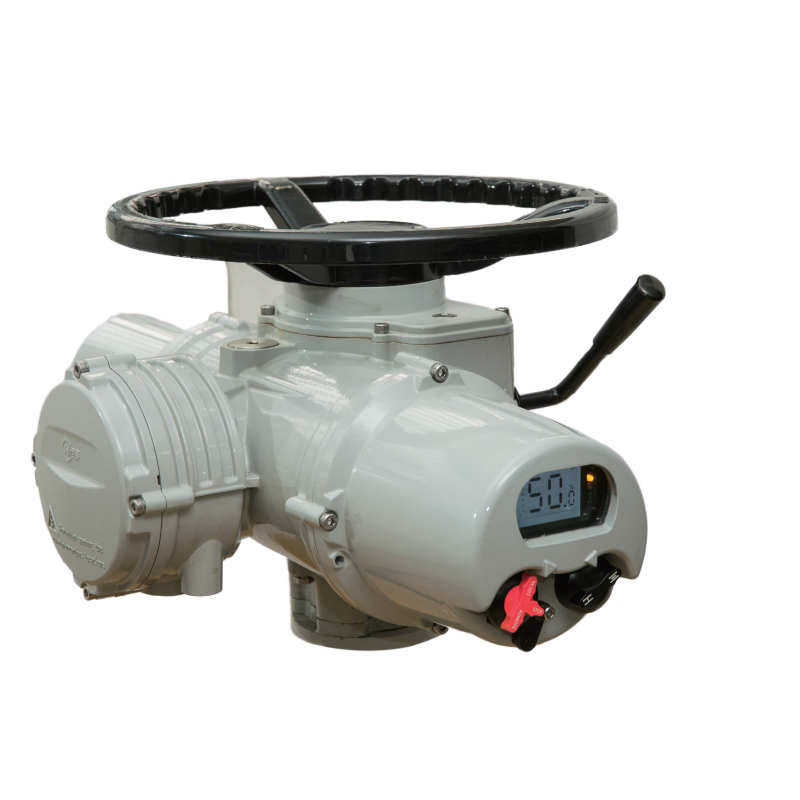
Some process systems need the valve to move to a safe position if normal power is lost.
Depending on the application, the safe position may be:
fully open,
fully closed,
or remain in the last position.
Fail-safe requirements are particularly important in:
emergency shutdown systems,
hazardous process lines,
fuel systems,
chemical processing,
remote pipelines,
and critical infrastructure.
Hengchun's product portfolio includes actuator configurations with battery-capacitor reset and other power-loss response solutions for applications requiring automatic safe positioning.
A fail-safe feature should be specified as part of the system safety philosophy rather than treated as a general accessory.
Certain applications require more than reliable normal operation.
They may require documented functional safety performance.
For safety-related valve systems, buyers may need to evaluate:
SIL requirement,
failure behavior,
diagnostic coverage,
proof-test requirements,
certification,
and safety lifecycle documentation.
Hengchun's current product portfolio and certification information includes SIL-related certifications and solutions for industrial safety applications.
The required safety level should come from the project's hazard and risk assessment.
Actuator selection changes according to the industry.
Typical priorities include:
hazardous-area compliance,
fail-safe behavior,
corrosion resistance,
remote control,
and reliable shutdown.
Hengchun identifies pipeline, refinery, and other oil-and-gas valve control among the application areas for its industrial actuators.
Power plants may require:
reliable modulating control,
high-temperature process compatibility,
remote operation,
and long service life.
Water-treatment and municipal systems often prioritize:
outdoor protection,
remote control,
reliability,
low maintenance,
and straightforward system integration.
Marine applications may require enhanced corrosion resistance and industry-specific certification.
Nuclear applications require substantially stricter design, qualification, documentation, seismic, and lifecycle requirements than general industrial service.
Hengchun's current portfolio includes nuclear-grade actuator products for specialized nuclear power applications.
This demonstrates why actuator selection must always be application-specific.
A common purchasing mistake is to compare actuators using only one number:
“This actuator has enough torque, so it should work.”
Torque is necessary, but it is only one part of the specification.
Two actuators with the same rated torque may differ substantially in:
duty cycle,
travel time,
positioning accuracy,
control functions,
enclosure protection,
explosion protection,
communication,
certifications,
operating temperature,
and fail-safe capability.
A professional actuator selection should evaluate the complete system.
Before requesting a quotation, collect the following information:
Selection Item | Information to Provide |
|---|---|
Valve type | Ball, butterfly, gate, globe, plug, damper, etc. |
Valve size | Nominal diameter |
Required motion | Quarter-turn, multi-turn, or linear |
Torque / thrust | Valve manufacturer data |
Travel | Rotation angle or number of turns |
Control mode | On-off or modulating |
Duty cycle | Operating frequency |
Travel time | Required opening/closing speed |
Power supply | Voltage, phase, frequency |
Control signal | Digital, 4–20 mA, etc. |
Feedback | Position, open/close, alarm |
Communication | Modbus, Profibus, FF, HART, etc. |
Environment | Indoor, outdoor, marine, corrosive |
IP protection | Required enclosure rating |
Hazardous area | Explosion-proof classification |
Functional safety | SIL or other requirements |
Fail-safe action | Open, close, or stay |
Mounting | Valve flange and stem dimensions |
Ambient temperature | Minimum and maximum |
Certification | Project or industry requirements |
This information gives the actuator manufacturer a much stronger basis for model selection.
Electric valve actuators are part of a complete automation system.
The actuator may need to interface with:
valves,
DCS,
PLC,
instrumentation,
emergency shutdown logic,
communication networks,
and field power systems.
Technical support therefore matters before and after purchase.
A capable supplier should be able to assist with:
actuator sizing,
valve matching,
control configuration,
communication selection,
certification matching,
installation,
commissioning,
troubleshooting,
and maintenance.
Yangzhou Hengchun Electronics Co., Ltd. was founded in 1994 and focuses on fluid control and automated actuation system solutions. The company is headquartered in Hanjiang Industrial Park, Yangzhou, with a 40,000 m² site and more than 38,000 m² of workshop space.
Its product portfolio includes intelligent multi-turn, part-turn, specialized safety, and other industrial actuator solutions for fluid-control applications.
The best electric valve actuator is not simply the actuator with the highest torque, most functions, or strongest enclosure.
It is the actuator that correctly matches:
the valve + process + control system + environment + safety requirement
For a simple isolation ball valve, a quarter-turn on-off actuator may be sufficient.
For a control valve in continuous regulation, positioning accuracy and duty cycle become much more important.
For hazardous or safety-related applications, certification, fail-safe function, explosion protection, and functional safety may become the deciding factors.
The selection should therefore be based on the complete operating condition rather than a single specification.
Start with the valve manufacturer's torque or thrust requirement, then consider breakaway torque, running torque, seating torque, differential pressure, operating conditions, and an appropriate engineering margin.
A quarter-turn actuator typically rotates approximately 90° and is commonly used for ball and butterfly valves. A multi-turn actuator rotates through multiple revolutions and is commonly used for gate and globe valves.
Choose on-off control when the valve mainly operates fully open or fully closed. Choose modulating control when the valve must stop at intermediate positions to regulate flow, pressure, temperature, or another process variable.
The required rating depends on the installation environment. Outdoor, wet, dusty, or washdown conditions generally require greater enclosure protection than a clean indoor location.
Only if the actuator will be installed in a classified hazardous area where flammable gas, vapor, or dust may be present. The actuator certification must match the project's actual hazardous-area requirements.
Provide the valve type, valve size, torque or thrust, required travel, duty cycle, power supply, control signal, communication protocol, environment, protection rating, safety requirements, and valve mounting dimensions.
Many intelligent actuators can integrate with DCS and PLC systems using hardwired signals, analog control, or supported industrial communication protocols. The required interface should be confirmed before ordering.
Selecting an electric valve actuator is a system-engineering decision.
Start with the valve, determine the required torque or thrust, confirm travel and operating speed, then evaluate duty cycle, control mode, power supply, environmental protection, communication, safety, and mounting compatibility.
For demanding industrial applications, also consider certification, fail-safe operation, functional safety, and long-term technical support.
If you are selecting an Electric Valve Actuator for a new project, providing complete valve and process data will make model matching faster and more accurate.
Yangzhou Hengchun Electronics can evaluate valve type, torque, control requirements, environment, certification, and application conditions to support actuator selection for industrial fluid-control systems.


